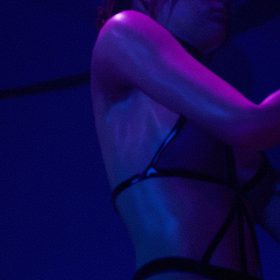
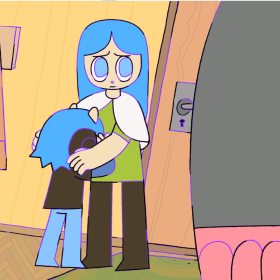
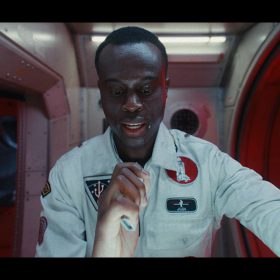
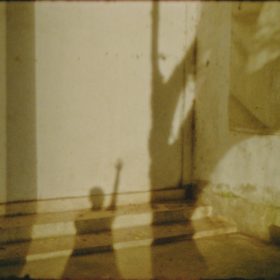
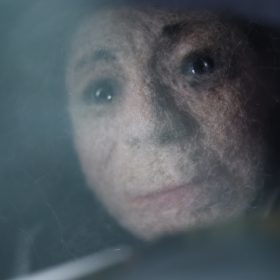
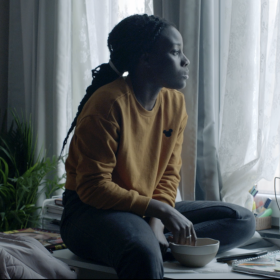
SOUND ASLEEP is currently on its festival journey, but has already screened or been accepted to the 50th Cleveland International Film Festival, Landshuter Kurzfilmfestival, The Lake County Film Festival, CineSol Film Festival, Fastnet Film Festival, Cardiff Mini Film Festival, and Lynchburg Film Festival. It appears on T-Port courtesy of our partners at Festival Formula.
Hi Nadaav, would you mind introducing yourself in a few lines?
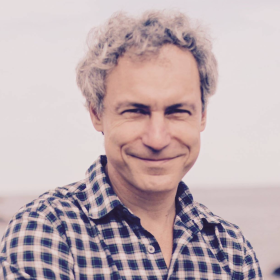
I’m a Scottish writer and director. I’ve been making films since I left school, which was long enough ago that I won’t specify the year!
Much of my career has been in factual and documentary television, including work on long-running British series such as Panorama (BBC One), Time Team (Channel 4), After Dark (BBC Four) and Blue Peter (BBC One). Even in my most serious current affairs work, I was usually trying to smuggle in a moment of humour, so it was probably inevitable that I would start making comedy.
My first short to play festivals was The Opera Singer (2010). Since then, I’ve balanced filmmaking with broadcast work and my parallel life as a solo comedy performer.

Do you have a philosophy behind your filmmaking?
I’ve never really thought about it in those terms. A “philosophy” is something other people might discuss if you’re lucky enough to be an artist who gets discussed. I don’t tend to frame it that way. I just have taste, humour, and subjects that intrigue me.
In a lot of my work, both on film and on stage, I use comedy to disarm the audience. It’s a way of bringing people towards topics they might not otherwise choose to confront. Any “message” is usually buried fairly deep. I’m not very interested in announcing what the work is about. It’s a lot more fun and empowering to let audiences find that for themselves. And they always surprise me.
I’m ok with letting them work out the tone, genre, and how to engage with the work for themselves, and I’m ok with a bit of awkwardness or uncertainty at the start. That’s harder and harder in the attention economy, but I still think it’s powerful. The payoff for the viewer and the scope it offers me as a storyteller is much greater.
I began in documentary because it felt like the place to do “important” work. During the pandemic, when many of us were struggling, I realised that comedy isn’t the lesser field at all. The simple act of giving people a moment of laughter and relief is a seriously good thing.
If you could watch one film on a loop forever, what would it be?
One film. Forever. Sounds like hell. No thanks!
How did you first start working on SOUND ASLEEP? What was the process like and what first sparked the idea to make it?The inspiration came from two personal places:
The lead character spends the night trying to deal with the sounds that keep him awake. When I say it’s personal, people assume I must suffer from insomnia. I don’t. I wasn’t diagnosed until long after I wrote the film, but in hindsight, it’s very much an ADHD narrative.
Like the character, I get distracted from almost anything, even going to bed. It’s never been quite as dramatic for me as for the character in the film, though! At the time I wrote the film, I didn’t have any other way of talking about what I experienced.
The second spark was a very specific university memory. One night, I was kept awake by extremely loud, extremely committed amorous noises. All night!
When I say loud, I mean loud. I was not going to get to sleep. I lived in a very small student residence where I knew everyone. My mind was racing. I wanted to know who was keeping me awake. Turns out, I was not alone. As I explored the corridors, I encountered other tired, confused students also trying to solve the mystery.
Together, we searched the entire building. Nothing. Eventually, we went out to our overgrown garden outside. Maybe we’d find a clue about which room this was coming from outside. But it was completely silent out there.
As I turned back towards the building, in the garden’s long grass, I nearly tripped over something.
It was a bottom.
You can probably fill in the rest.
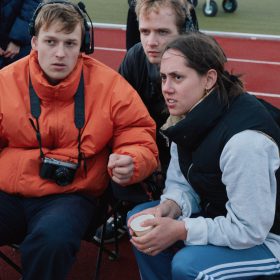
And then when you began the practical side, how did the production process pan out for you?
It took a long time. That’s all down to budget.
We were repeatedly shortlisted for funding but never quite awarded it. That’s a frustrating process so eventually we ran a Kickstarter – always an emotional rollercoaster. We got it over the line, but the budget was very tight. And the ambition was bold.