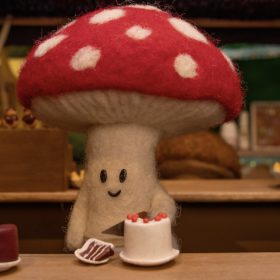
Veera Lamminpää is a Finnish filmmaker, animator, and storyteller whose award-winning short film Mereneläviä (FISH RIVER ANTHOLOGY) combines stop-motion animation and musical poetry to explore everyday interactions and hidden inner lives. Her work appears on T-Port courtesy of our partners at European Film Promotion: Future Frames.
With a background that spans writing, directing, production design, and graphic arts, Lamminpää brings a multidisciplinary approach to filmmaking. In this interview, she reflects on her creative process, the challenges of independent animation, and her belief in storytelling as a tool for empathy and connection.
Hi Veera, could you please introduce yourself?
I’m a director, writer… And a producer, production designer, and graphic artist when inspiration (or necessity) strikes. I’ve worn quite many hats over the years. I’m curious about all aspects of filmmaking and always hoping to deepen my understanding of different roles and areas of expertise.
I’ve been working in the film industry for nearly a decade. I got my start as a writer for television shows, while also developing my own projects on the side. It didn’t take long for me to realize that I couldn’t imagine anyone else directing my original ideas, so I started directing them myself. I’ve completed six short films so far, the most recent of which – FISH RIVER ANTHOLOGY – was screened at the Karlovy Vary Film Festival as part of the Future Frames program. The film is also my graduation project from the Master’s program in Film Directing at ELO Film School, Aalto University.
What inspired you to become a filmmaker?
When I was young, I watched a lot of movies and TV series. Some of them made such a big impression on me that, for example, I even planned to apply to the Police University College because I was a fan of a certain cop show. Fortunately, I realized that I didn’t actually like real police work, but rather the stories told by good series and films. So I went in that direction instead, and I’m glad I did. I’m probably too sensitive for a career in law enforcement.
In some ways, my career choice is a good example of the power of filmmaking and how it can inspire people in their lives.

Do you have a philosophy behind your filmmaking?
I want to make films that help people feel less alone. I believe film has the power to do that. I want the audience to see that, despite our differences, we’re all much the same inside, and none of us are alone with our worries, joys, and dreams. If I can inspire people to reflect on their lives and think about how to make things better for us all, whether that’s by drawing attention to a problematic issue or highlighting something beautiful in the world, I feel I’ve succeeded as an artist.
Also, this might be a trifling matter, but still: As a writer-director, I’m responsible for guiding the film’s vision from conception to completion, which means I bear the greatest responsibility for its successes and failures. Even so, I believe filmmaking is a team effort. That’s why I’ve made it a rule that my films won’t have “a Veera Lamminpää film” on the title card or posters. I know it’s a marketing convention, and maybe no one cares, but it’s important to me to recognize the work of all the other artists involved by not claiming it solely as mine.

If you could watch one film on a loop forever, what would it be?
POINT BREAK (1991), directed by Kathryn Bigelow. Years ago, I had an assignment related to the film and ended up watching it about ten times in five days, and I liked it more with each viewing. Is it the best film ever made? No. Is it extremely entertaining and endlessly quotable? Absolutely.
Alternatively, pretty much anything by Satoshi Kon.

How did you first start working on this film? What was the process like and what first sparked the idea to make it?
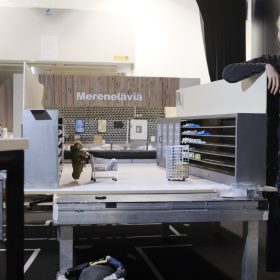
The starting point was the act of queuing at a supermarket, and how much can fit into that mundane, everyday moment. You’re sharing a space with other people in the queue, but at the same time, everyone pretends the others don’t exist. You have time to look at the fish, with their empty eyes, and remember that since they’re a fresh product, they were swimming just a moment ago, searching for food… Just like we are when we line up to fetch them from the store.
The international title of the film refers to the poetry collection Spoon River Anthology by Edgar Lee Masters. It inspired me to write the characters’ dialogue as small poems, which in turn led me to turn the film into a musical.

And then when you began the practical side, how did the production process pan out for you?
I knew from the start we wouldn’t have much of a budget, so I had to learn how to do a lot of things myself, like set-building and puppet-making. It was time-consuming but very rewarding, and it challenged us to get creative. FISH RIVER ANTHOLOGY is my first animation project, and while I’ve done a number of live-action shorts, the learning curve was pretty steep. But since it was a student film, I was given the space to experiment and learn, and I received guidance from my peers and professors.

What were the biggest challenges you encountered during making your film?
In the beginning, I grossly underestimated how much time we would need to shoot the whole thing. We worked in our university’s tiny cellar space, and at one point, we had to give it up for a couple of months in the middle of production. So we had to dismantle the entire set, pack it up, and store it in a closet somewhere. Considering the amount of miniature details, from tiny lemons to hundreds of microwave meals, it was quite an operation. I really appreciate my cinematographer, Arttu Liimatta, for his support during the dismantling (both mental and physical).
How was it to collaborate with your cast and crew? Have you formed any particular meaningful connections?
I’m writing another stop-motion short film at the moment, called ODD BIRDS, and the plan is to collaborate with the key crew who worked on FISH RIVER ANTHOLOGY. We were a very small team, and we worked really well together, so I’d love to keep going. Also, since the last production was a student film where no one got paid, I’d love to be able to offer paid work to the people who worked their asses off on that film.

Tell us about the sound choices in your film – what type of score did you use and why? What other types of sounds did you use?
Having a talented composer is key to any successful musical. I’ve been a fan of our composer, Iiti Yli-Harja, for a long time, so it was a joy to get to work with her. On top of being a fantastic musician, she is also a filmmaker, and she was actually the person who first introduced me to stop-motion as a technique.
Iiti was the only crew member I hadn’t worked with before, so there’s always a level of anxiety about whether your ideas will match. But when I heard the first demo of the score, I just burst into tears. Iiti understood exactly what I was going for, and that gave me the confidence that things would go well for this film.
What was it like for you working with the actors you cast? Do you have a technique for directing actors you can tell us about?
I specifically wanted to work with singers who are also actors or filmmakers. Each character in the film has only a short time to establish themselves, which means you sometimes have to sacrifice vocal purity in order to build character. All of our characters are quite imperfect, so every note they fail to hit tells us something about them: what they struggle to say versus which words come to them naturally.

Can you share the most important lessons you learned through the process of making the film?
Well, number one is that I learned to love stop-motion animation as a technique. I hope to use it in the future, both for fully animated pieces and hybrid productions. There’s also a level of world-building and planning associated with animation that I’m going to bring into my live-action projects going forward.
If you could go back in time to pre-production and give yourself one piece of advice, what would it be?
I don’t necessarily have any major regrets regarding this production, as all my failures taught me something important. That being said, I would slap my past self across the face and tell her to structure her life better. At the same time I was working on this film, I was shooting another short film, studying full-time, and working two part-time jobs. So, looking back, I would tell myself to let go of something and not burn myself out.

What would you like people to take away from your film?
Everything that’s alive has their personal story: the strangers next to you at the supermarket, the fish lying on the counter, and even the flies trying to get their piece of the catch. I think it’s important to recognize that we are all main characters only in our own stories, and that everyone around us has an inner world just as rich and complicated as ours. If the film helps people feel more empathy toward all living things, then I feel I’ve achieved something worthwhile.
If you were to have infinite resources – walk us through your fantasy film project. What’s next for you on the filmmaking front?
I’m currently drawing a storyboard for the short film project ODD BIRDS which I mentioned earlier. I also have a couple of features in early development: one is a sci-fi comedy with ecological themes, and the other is a hybrid project about bugs, children, and the end of the world. Both of them are still looking for a home, so if you’re a producer searching for a crazy new project for your slate – look no further!
Submit Your Short To T-Port Today
T-Port films are only accessible to professionals, so your premiere status will not be affected.
Stake your place in the next generation of filmmakers waiting to be discovered for only 15 Euros / year. Find out more on our website and get started with T-Port today.
Or sign up for our newsletter to get regular updates on the current trends and exciting innovations in the short film universe.