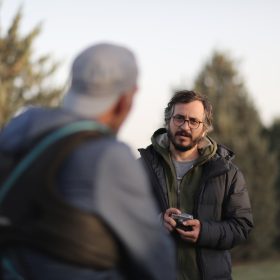
Skander Kourgli completed his graduation film, DEAD AIR, as part of his studies at Filmakademie Wien, not knowing where the film would end up. After adventures in shooting on film and creating a period piece in a soon-to-be demolished radio station, he learned his short is headed to PÖFF – Tallinn Black Nights Film Festival in Estonia. We chatted to the producer about the stresses of such an elaborate shoot and his vision of the future.

Hi Skander, could you introduce yourself?
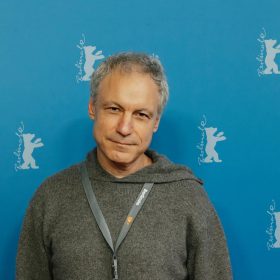
I am an emerging film producer based in Vienna. From 2011 to 2014, I studied Digital Film and Animation at SAE Institute Vienna. Between 2016 and 2018, I worked as a stage manager for several Austrian public broadcasting programs (Kulturmontag, Brieflosshow, ZIB 2) and produced image films, music videos, and commercials at Frame Fatale Films.
Since 2021, I have been studying Film Production at the Film Academy Vienna. My most recent project as a producer, the comedy THE BEST SHORT FILM OF ALL TIME (2022), was screened at festivals including Hof International Film Festival and the Landshut Short Film Festival. The comedy BAD GRAMMAR (2025) will have its premiere at Internationale Hofer Filmtage this Oktober, the historical drama DEAD AIR (2025) will premiere at PÖFF Shorts in November, and the horror film HUNGERFRESSER (eng: Hunger Feeder) is currently in post production.

What inspired you to become a filmmaker?
The true inspiration is sometimes hard to describe. I had a small family run video rental in the same block where I grew up, where I spent almost all of my afterschool free time. Any assignment in school, that was to either write something or “make a video about it”, was an obvious choice for me. My childhood wasn’t always so rosy, so escaping into other worlds through films, rather than books – which was a particularly hard blow for my lovely mom, who was a librarian all her life – was probably the biggest driver in the decision that I wanted to make films when I grew up.

Do you have a philosophy behind your filmmaking? Could you tell us about it?
Maybe I already implied it, but I’ll elaborate on it. The creations of a reality other than the one you live yourself. To live vicariously through the protagonists – those that have friends that accomplish something together or see foreign lands or even worlds. That feeling is what ultimately drives all my filmmaking endeavours. No matter the genre really – depending on the season, the weather or simply put: the mood. I’d find everything in that videostore. And I always envisioned my movies up on those shelves.

If you could watch one film on a loop forever, what would it be?
That is an answer I probably will never be able to answer– the cornucopia of films not yet seen would forbid me to make any truthful decision. But my wife loves to watch LITTLE WOMEN (the one with Saoirse Ronan) and THE BALLAD OF WALLIS ISLAND on repeat; and I watch it with her.

How did you first start working on this film? What was the process like and what first sparked the idea to make it?
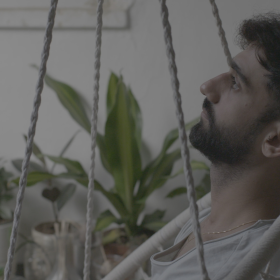
It was my first film at Filmakademie Wien. Andrej approached me to say that the production student of his last film wouldn’t be on board this time. I knew Andrej from our high school choir. He pitched the idea that we had to shoot a film at the Funkhaus (Radio Station) soon, because the historic building is being vacated as we speak and soon would be turned into luxury apartments. In 2023 he had worked on this story for some time, but now really delved deep into archival footage and interviewed former staff that worked the night the Yugoslavian war was beginning. He always asked how it felt, when we first heard of the twin towers falling or the first Russian rockets hit Kiev – and in turn how the person feels that has to deliver such a message.
Needless to say: I was hooked. It was such a breath of fresh air from other more typical student drama films, that I was immediately on board.
And then when you began the practical side, how did the production process pan out for you?
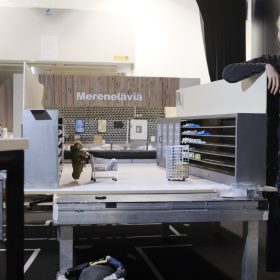
The big question mark was the Building of the radio station itself. We had to dress it back to 1991 – believably. And even though the locations we used were empty – getting the official approval to shoot was shaky until a two before principal photography. Our planned 3 days of set dec and dressing turned into a whole week. And everyone from my wife to my mom (and countless others) helped me to get everything ready to shoot.

What were the biggest challenges you encountered during making your film?
Shooting on a tight budget and during a blizzard was hard enough – but then again student filmmaking is never easy. It was my first time shooting on 35mm. We had 12 rolls of 122m, a thirteenth one was a third used up by technical test shoots.
And when, after the first half of the first day the Clapper/Loader Jasmin walked up to me and explained what a “mag jam” was and how many meters we just lost, that was the most stressful. I think it happened twice more.

How was it to collaborate with your cast and crew?
The old saying “we grew to be one big family” really rang true. It helped that even though the building was huge, we all had a good breakfast and lunch together at the same tables for almost two weeks. That kind of routine creates bonds that often exceed long standing acquaintances. And we were lucky enough that the whole crew really knew what they were doing and worked in lockstep to solve any problem that could arise and did so with the attitude of seasoned pirates on a truly worthy vessel, exhausted but happy.

Tell us about the sound choices in your film
Andrej approached Florin Gorgos, a Composer and Student of MDW. In the script it said that before the early morning news, the night program would be “Jazz Nacht” – jazz night. So Florin in accordance with Andrej organised musical students of the MDW to produce jazz tracks that would “bleed” from the reality of being played on the stations in house PA to a more faded diegetic music that would juxtapose the cruel reality of what was about to happen.
The location sound was done fairly traditionally but no less importantly by my director friend Daniel Holzberg and Niki Gehrer is responsible for the amazing sound design and mix.

What were your main goals and techniques in creating the visual style of your film?
I want to refer to Florian Noever (cinematographer) to answer that question:
FLORIAN: “When Andrej and I first discussed the script and the film’s look, two aspects became clear to us relatively quickly: we wanted to realise the project on film and tell the story in the Cinemascope 2.39:1 format.
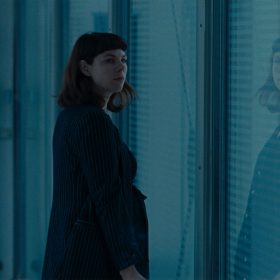
The world of DEAD AIR is dark and lonely. Our protagonists find themselves inside a building, without knowing exactly what is happening just beyond the border of their world. We want to take this aspect of ignorance as a guiding principle for the cinematography. We want to visually immerse the viewers in this ignorance. We achieve this through lighting that sometimes lets the protagonists disappear into the shadows, through details that only show part of the information, through dialogue where we don’t see the characters, and through camera movements that build tension.
To achieve a high-contrast, harsh, and grainy look, we decided on the Super 35 2-perf format. To avoid creating the look digitally, we pushed the film stock one stop in development. This leads to more saturated colours, stronger contrast, and more grain. The camera in our story is independent and not the viewpoint of a character. It knows more than the protagonists in the ORF Funkhaus, yet it doesn’t reveal everything to the viewers. To be able to isolate the protagonists, we sometimes work with long focal lengths. In intimate moments, we move the camera closer to the characters. At the same time, wide shots of the Funkhaus are an important part of the visual language to shape the film’s mood.
In terms of lighting, I work as simply as possible. It is important to me to light the majority of the set in a single, comprehensive way to give Andrej and the actors as much freedom as possible. The world of the ORF Funkhaus is bathed in harsh light, either green or warm. We worked deliberately with the existing lighting moods, enhancing and modifying them to create a unique world. To follow the protagonists, we used dolly or Steadicam to achieve organic and controlled camera work and to generate tension. Tension, contrast, and textures are essential for the visual look of DEAD AIR, which is why we shot our film on analog 35mm.

What was it like for you working with the actors you cast? Do you have a technique for directing actors you can tell us about?
We’d probably have to schedule a whole additional interview with Andrej himself. I was fairly involved in the casting of the film. Joseph was the first on board, as he is a close friend of Andrejs and an integral part of pre-production. I met Wolfgang Lampl on an early Filmakademie film exercise (about chases, movement and eye lines) and remembered him when I read the role of The Technician. Eva Maria Frank was a recommendation by Daniel Holzberg and Andrej and I went to see a play of hers at Bronski & Grünberg Theater in Wien. Andrej had a contact with Alina Schaller and Janja Krklec was the only one we found through an open casting call. (Having actually fled from former Yugoslavia, knowing more about the pain than we could imagine)
Daniel Holzberg spoke the temp track for the Military General on the phone and only very close to mixing the movie, Andrej had talked to Cornelius Obonya as a hail mary if he were interested in helping us – and he gracefully did.
Can you share the most important lessons you learned through the process of making the film?
Prepare as much as you can and then let go. No need to micromanage or stress about things you cannot change.

How does it feel for you, as an artist, to see your work being accepted to festivals and more?
The film has been on my mind on and off for more than 2 years. It’s more a feeling of “finally” than a big hoorah. That being said, you’ll probably see me beaming and smiling from ear to ear at the first screening.
Did you have a specific strategy for promoting your film? If so, please tell us about it.
It was always our goal to get somebody with more (or any) experience in selling the film for us – so needless to say we were immensely excited when Andrea Gatopoulos from Gargantua accepted our film into his roster.

What do you wish you’d known before you began the distribution process?
I still don’t know much about it. But I was more cynical in the beginning, thinking that distributors are in an unholy alliance with programmers. I don’t believe that is the case anymore. But with the right package and enough effort to be a lighthouse among the sea of “content” a film can find its place in the festival landscape.
What’s next for you on the filmmaking front?
Finishing the horror short HUNGERFRESSER (eng: Hunger Feeder) and getting it on T-Port and onto the big screen!
What does it mean to have your short screening at Tallinn?
It means the world to us to premier with “the wolves”. We only heard rave reviews about the amazing hospitality the Estonians offer and we are anxious to see how the people on the cinema seats react.
What excites you most about heading to film festivals like Tallinn?
Numerous big Festivals had declined. We thought we were done. Nobody else sees what we see in our movie. Or so we thought – but Andrea kept us in good spirits. “You just wait” he said. And now we’re heading to an “A” Festival. It’s a dream come true that we didn’t even know we could dare to dream.
Submit Your Short To T-Port Today
T-Port films are only accessible to professionals, so your premiere status will not be affected.Stake your place in the next generation of filmmakers waiting to be discovered for only 15 Euros / year. Find out more on our website and get started with T-Port today.
Or sign up for our newsletter to get regular updates on the current trends and exciting innovations in the short film universe.