Nadaav Soudry learned his craft by working on serious documentaries on British TV, so he was in for a learning curve with his comedic short film SOUND ASLEEP. We caught up with the filmmaker to find out about what it was like to work as part of a team, why editing comedy is a different universe, the absolute intricacy of sound design within the film, and what it was like to work with legendary British actor Danny John Jules.
SOUND ASLEEP is currently on its festival journey, but has already screened or been accepted to the 50th Cleveland International Film Festival, Landshuter Kurzfilmfestival, The Lake County Film Festival, CineSol Film Festival, Fastnet Film Festival, Cardiff Mini Film Festival, and Lynchburg Film Festival. It appears on T-Port courtesy of our partners at Festival Formula.

Hi Nadaav, would you mind introducing yourself in a few lines?
I’m a Scottish writer and director. I’ve been making films since I left school, which was long enough ago that I won’t specify the year!
Much of my career has been in factual and documentary television, including work on long-running British series such as Panorama (BBC One), Time Team (Channel 4), After Dark (BBC Four) and Blue Peter (BBC One). Even in my most serious current affairs work, I was usually trying to smuggle in a moment of humour, so it was probably inevitable that I would start making comedy.
My first short to play festivals was The Opera Singer (2010). Since then, I’ve balanced filmmaking with broadcast work and my parallel life as a solo comedy performer.

Do you have a philosophy behind your filmmaking?
I’ve never really thought about it in those terms. A “philosophy” is something other people might discuss if you’re lucky enough to be an artist who gets discussed. I don’t tend to frame it that way. I just have taste, humour, and subjects that intrigue me.
In a lot of my work, both on film and on stage, I use comedy to disarm the audience. It’s a way of bringing people towards topics they might not otherwise choose to confront. Any “message” is usually buried fairly deep. I’m not very interested in announcing what the work is about. It’s a lot more fun and empowering to let audiences find that for themselves. And they always surprise me.
I’m ok with letting them work out the tone, genre, and how to engage with the work for themselves, and I’m ok with a bit of awkwardness or uncertainty at the start. That’s harder and harder in the attention economy, but I still think it’s powerful. The payoff for the viewer and the scope it offers me as a storyteller is much greater.
I began in documentary because it felt like the place to do “important” work. During the pandemic, when many of us were struggling, I realised that comedy isn’t the lesser field at all. The simple act of giving people a moment of laughter and relief is a seriously good thing.
If you could watch one film on a loop forever, what would it be?
One film. Forever. Sounds like hell. No thanks!

How did you first start working on SOUND ASLEEP? What was the process like and what first sparked the idea to make it?The inspiration came from two personal places:
The lead character spends the night trying to deal with the sounds that keep him awake. When I say it’s personal, people assume I must suffer from insomnia. I don’t. I wasn’t diagnosed until long after I wrote the film, but in hindsight, it’s very much an ADHD narrative.
Like the character, I get distracted from almost anything, even going to bed. It’s never been quite as dramatic for me as for the character in the film, though! At the time I wrote the film, I didn’t have any other way of talking about what I experienced.
The second spark was a very specific university memory. One night, I was kept awake by extremely loud, extremely committed amorous noises. All night!
When I say loud, I mean loud. I was not going to get to sleep. I lived in a very small student residence where I knew everyone. My mind was racing. I wanted to know who was keeping me awake. Turns out, I was not alone. As I explored the corridors, I encountered other tired, confused students also trying to solve the mystery.
Together, we searched the entire building. Nothing. Eventually, we went out to our overgrown garden outside. Maybe we’d find a clue about which room this was coming from outside. But it was completely silent out there.
As I turned back towards the building, in the garden’s long grass, I nearly tripped over something.
It was a bottom.
You can probably fill in the rest.
And then when you began the practical side, how did the production process pan out for you?
It took a long time. That’s all down to budget.
We were repeatedly shortlisted for funding but never quite awarded it. That’s a frustrating process so eventually we ran a Kickstarter – always an emotional rollercoaster. We got it over the line, but the budget was very tight. And the ambition was bold.
What were the biggest challenges you encountered during production?
Ambition versus money, without question. We wanted the film to feel cinematic and precise, but we were operating at the Lo/No Budget short-film level. Every choice had to be weighed carefully. Because the film is pure visual storytelling, and driven by performance and sound, there was nowhere to hide. If something didn’t work, it was obvious.
How was it to collaborate with your cast and crew? Have you formed any particular meaningful connections?
I was incredibly lucky with the collaborators on this film.
Danny John-Jules (The Cat from Red Dwarf) came on board to play the lead, and what he brought physically was extraordinary. It’s a one-actor film, and he had to respond to sound design that didn’t yet exist. That required precision, imagination and stamina. He can move in a way that very few actors can, and that physical control was exceptional and essential.
My regular DoP, Franklin Dow, once again made the film look far more rich and expensive than it was. For reasons I still don’t fully understand, despite having shot an Oscar-winning film and won an Emmy, he continues to work with me, and I’m very grateful for that. We wanted it to look like a “proper” movie, not a small short, and he absolutely delivered.
The visual effects were designed to be invisible. Cameron Smither, who has worked at a Hollywood scale far beyond anything I’ve experienced, brought a completely different level of thinking to the process. Working with him changed the way I understand not just post-production but film altogether.
Rich House on sound design also poured an extraordinary amount of care into the film. The sound is effectively another character. It is the invisible core of the film.
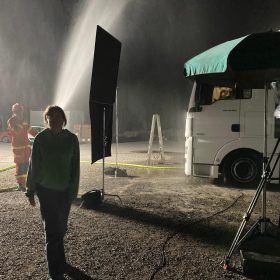
And then there’s the production team, who went above and beyond. They drove the kit from London to Madrid and back, taking turns to sleep. That level of commitment is humbling. We recently had a cast and crew screening, and it was genuinely moving to reconnect. Films take time, but the relationships last. I hope I get to work with all of them again.
Tell us about the sound choices in your film
Sound is the heart of this film. It’s the second character.
There’s no dialogue, and only one actor responding almost entirely to sound design, so everything depends on what you hear. We wanted the audience to hear what Dean hears, and to hear it the way he hears it. Tired. Frustrated. Isolated sounds in the lonely late night silence.
Sounds are heightened, exaggerated, and slightly distorted. They shift in tone and texture. They travel through walls, seep into the room, and reverberate around inside his head. They are louder than they should be, more intrusive than they would be in daytime. And when they finally stop, the relief is almost physical.
There is very little traditional score. Most of what you hear is sound design functioning as music. The one recurring musical element is an angelic choir that calls him back to bed. Through repetition, the audience quickly understands what it represents even when we don’t see the bed at all. But Dean resists it, battling the night.
We recorded production sound, but in the end almost everything was rebuilt in post. The final track is constructed from an enormous number of layered elements. It was painstaking, detailed work, but absolutely central to making the film function.
What was it like for you working with the actors you cast? Do you have a technique for directing actors you can tell us about?
Working with Danny was a gift. He’s a complete professional and he’s been making brilliant physical comedy for decades.
On a film like this, where there’s only one actor and nothing else to cut to, continuity and physical precision become critical. He was completely on top of his own movement from shot to shot, fully aware that even the smallest inconsistency would be visible.
What impressed me most was the control. I knew he was a brilliant physical performer, but the level of precision he brought exceeded my expectations. He played it wonderfully straight. The more seriously he treated the situation, the funnier it became.
In terms of directing technique, on more emotionally driven projects I use a lot of improvisations and abstract exercises. But that’s not what this film is. Here it was much more about trusting the casting. Once Danny and I quickly established the tone, it was about giving really minimal instruction and then making sure he had enough space to play with.
Can you share the most important lessons you learned through the process of making the film?
There were many lessons.
One of the biggest was that directing isn’t just a job on set, it’s a role you inhabit. Everyone wants the film to be great, but no one really knows if it will be. During the shoot, cast and crew place their trust in the director. You have to hold that confidence, even on your toughest days.
I learned that editing comedy is harder than almost any other genre and counterintuitive to everything I knew about editing, having previously cut documentaries and dramas.
And I was reminded how generous the filmmaking community can be. Beyond the cast and crew, a number of very experienced producers, writers, directors and editors took a lot of time to give me notes and feedback on both the script and the cut. I learned something from every one of them.
If you could go back in time to pre-production and give yourself one piece of advice, what would it be?
Public funding can feel like a lottery. Being repeatedly shortlisted cost us a lot of time before we decided to go it alone.
And budget for more than you think you need. The contingency line you’re tempted to trim is one you’ll be thankful for later.
How has the process of distributing the film been for you so far? What have you learned?It’s been fascinating. The film has connected particularly strongly in the US, which has been wonderful to see, even if I can’t always travel to attend those screenings.
The festival landscape is much more complicated than it was when I last screened, and also much more competitive, and expensive for filmmakers.
Filmmaking is hard. So enjoy every screening and the moments you share with the people who enjoy what you create.
What do you wish you’d known before you began the distribution process?
I think I came to it fairly well informed. It’s not my first rodeo and I took a lot of advice.
There are many different routes there for short films to travel. The landscape is fragmented, but that also means there are multiple points of connection.

If you were to have infinite resources – walk us through your fantasy film project
Dark, human comedy, rooted in behaviour but wildly ambitious in scale. Something that starts contained and escalates into the absurd. I’d spend a ridiculous amount on production design. I love it when a film has a really distinctive aesthetic that could only have been created by that particular group of collaborators.
Wait, infinite resources? Could I clone myself?
Submit Your Short To T-Port Today
T-Port films are only accessible to professionals, so your premiere status will not be affected.Stake your place in the next generation of filmmakers waiting to be discovered for only 15 Euros / year. Find out more on our website and get started with T-Port today.
Or sign up for our newsletter to get regular updates on the current trends and exciting innovations in the short film universe.