

Please read out our FAQ section to find out more.
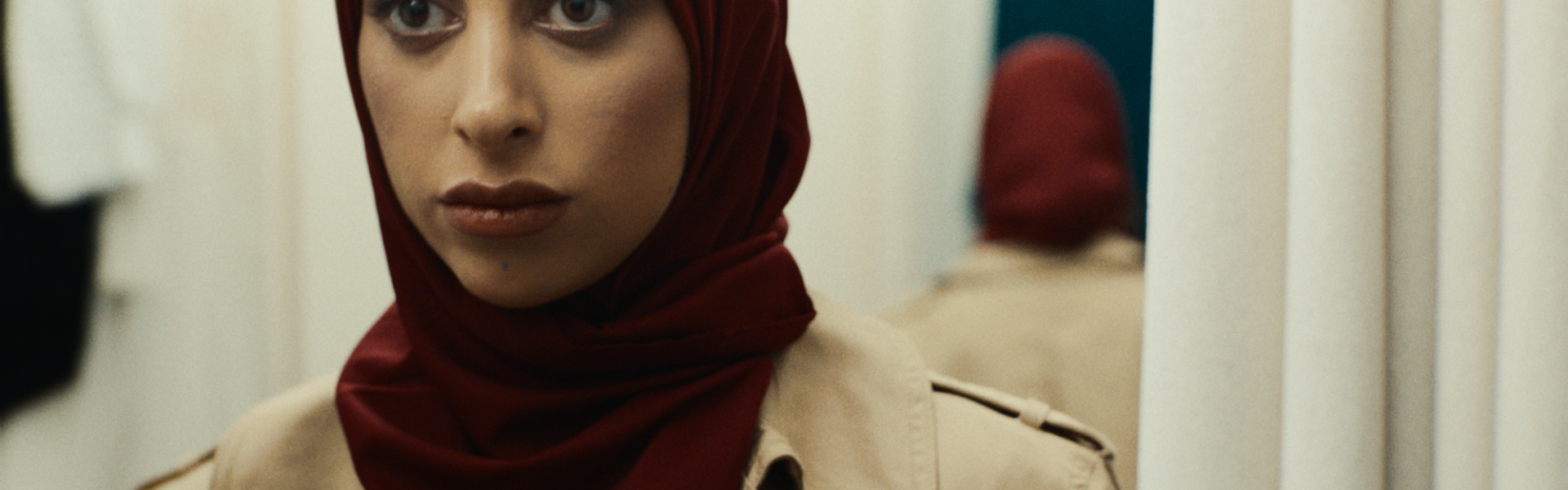


I watch for the moment when a gesture crosses a line without announcing itself. The film opens with a selfie. Maryam stands in front of an Elvis statue, phone raised, singing Hound Dog into the camera. The image is vertical, the lighting bad, the framing wrong. Then it cuts: Lima in an overexposed white space, moving through the frame in the camel coat like she owns it. Cinematic. Correct. Then that image pulls back too: Lima is simply trying on a coat in a store, and Maryam is watching her. The film's entire project is inside those two cuts. It started with something I wanted to observe without resolving. A look that lingers. The watching is not political. Or not only. Something held just a beat too long. Desire and politics operating on the same register, through the same gesture, without either canceling the other out. A shopkeeper dismisses Lima's wallet with a question: what should I do, return it to Hebron. Maryam hears a plan. What follows is a day of decisions she doesn't second-guess. Lima lives in a quiet Jerusalem suburb. Maryam doesn't know this yet. She is already on her way. The camera stays close and still. It doesn't move ahead of her or pull away. When Maryam leaves a scene, the camera sometimes stays. With the street. With the man smoking by the ATM. With a city that was here before she arrived and will continue without her. All locations are authentic. The Arab communities whose spaces we entered gave us their time and their homes. The casting honors the communities it represents. The only person who stands out is the protagonist. The camera notices. The film makes fun of one person. The American tourist. Who happens to be me. Lima sees Maryam running away, the cab already leaving. She closes the gate. Like a lady. She continues to her house, her phone call, her life. At the Elvis diner, Maryam tells Tamir she thinks she should move here. He looks at her and turns away. The credits begin. The film cuts back to the Elvis statue: Maryam singing Hound Dog, vertical frame, someone else holding the camera this time. Someone watching her. She doesn't know. Elvis recorded a song that belonged to someone else, made it his own, and became iconic. The film doesn't explain what that means. It doesn't need to.
Country: United States of America (USA)
Yocheved “Yochi” Feinerman is a writer-director based in Israel, where she immigrated from the United States, enrolled in film school in her forties, and is raising four children. A graduate of Minshar School of Art, her films examine the gap between intention and impact, where empathy reveals itself as a form of claim. She works with contained situations and close observation, staying with moments as they unfold rather than moving ahead of them. She does not resolve what she observes.

Dina, a Haredi woman, enters a Tel Aviv “Sexy Shop” to buy a gift for...

A young woman visits her father’s grave with her mother on the eve of her...
Maryam, an American Jewish tourist, fixates on Lima, a Palestinian woman, trying on a coat...


